
We’re becoming Sallie—ready to help you pay for school, grow your savings, and do way more. 

Cosigning can help your student succeed

Competitive Undergraduate Rates:
Fixed rates: 2.89% - 17.49% APRfootnote 1
Variable rates: 3.75% - 16.37% APRfootnote 1
Lowest rates shown include the auto debit discount. Only the most creditworthy applicants who choose the interest repayment option may receive the lowest rate.

We keep it simple
Apply in minutes with 3 simple steps

1. Tell us some basics


2. Invite your student


3. Sign and accept


You’re there for your student

Many students don’t have the credit history to take out a loan on their own. With a creditworthy cosigner, your student may have a better chance to be approved and may get a lower interest rate. A cosigner can be a parent, or any creditworthy adult who, like the borrower, will be fully responsible for making on-time payments on the loan.

footnote 2

You both can feel confident about cosigning

Up to 100% coverage

From tuition to living expenses, 100% of all your student’s school-certified costs can be coveredfootnote 3

Cosigner release

Your student can apply to remove you from the loan after graduation, making 12 on-time payments, and meeting other requirements.footnote 4

No upfront fees

Families saved over $345 million compared to PLUS origination fees over the last 10 years.footnote 5

Save on your total costs

If you choose to make payments while your student is in school, the total cost of your loan may be lower.footnote 1

Compare interest rate types

You have options. See whether fixed or variable rates might be best for you and your student. 

Fixed rates

Fixed means your interest rate never changes.

2.89%

to 17.49% APRfootnote 1

If you want a predictable monthly payment, this is the way to go.

Lowest rates shown include the autopay interest rate reduction. Only the most creditworthy applicants who choose the interest repayment option may receive the lowest rate.
Variable rates

Variable interest rates go up or down as the market changes.

3.75%

to 16.37% APRfootnote 1

This means your monthly payments may also change—they might be higher if interest rates rise and lower if they fall. 
Lowest rates shown include the auto debit discount. Only the most creditworthy applicants who choose the interest repayment option may receive the lowest rate.
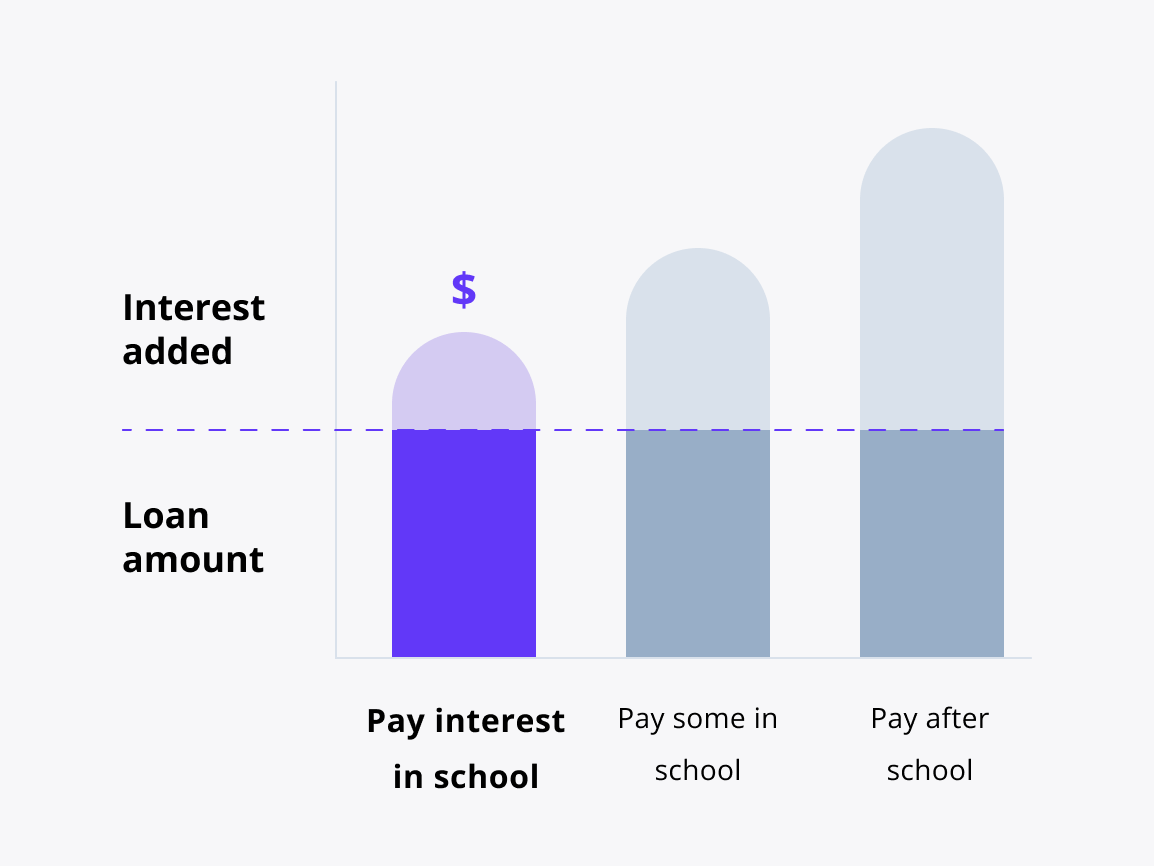
Graph showing interest repayment option

Interest repayment option

How does it work?
You pay your interest every month your student is in school and in grace (the 6 months after).footnote 1
 
This is a great option if you want to save the most.
Freshman students may save 17% on their total loan cost by choosing interest repayment instead of deferred repayment.footnote 6
 
Keep in mind:
You might have higher monthly payments, but the total cost of your loan may be lower.
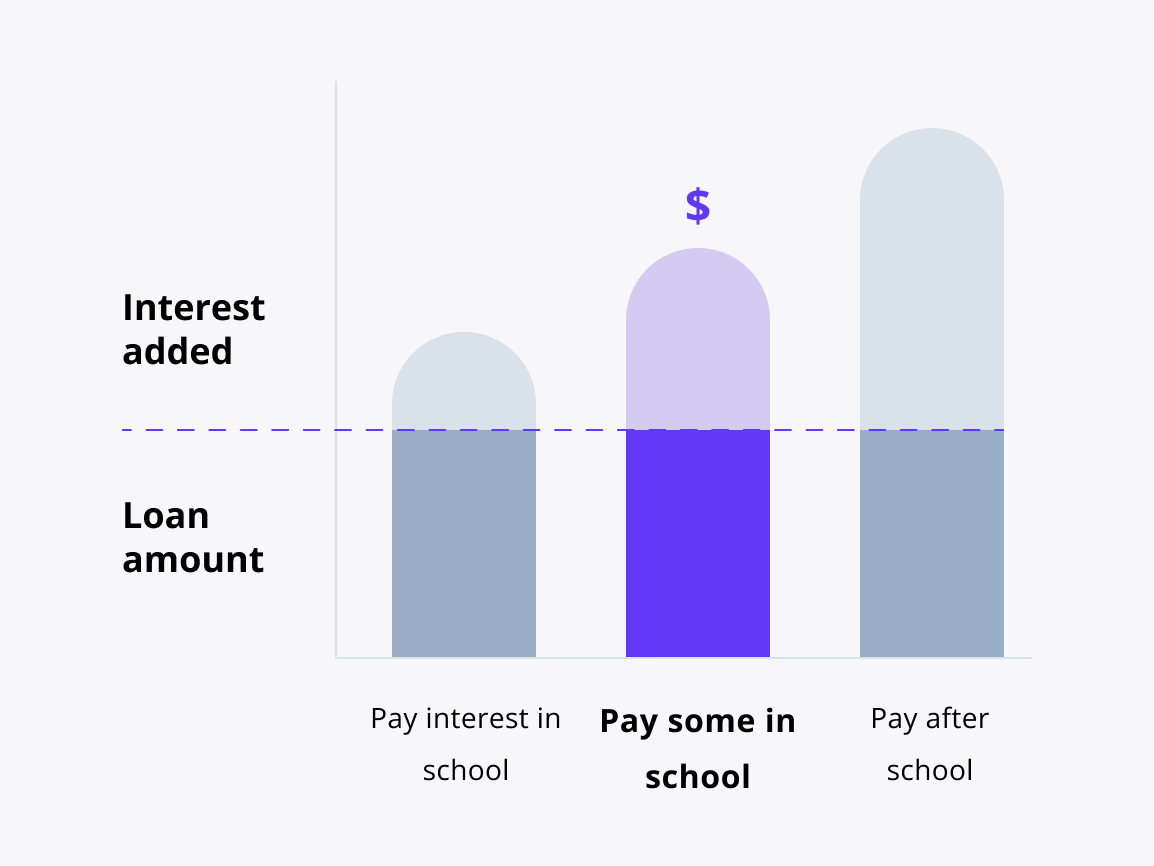
Graph showing fixed repayment option

Fixed repayment option

How does it work? 
A payment of $25 every monthfootnote 7 is required while your student is in school and in grace.footnote 1

This is a great option if you want to make a dent in payments from the start.
Freshman students may save 7% on their total loan cost by choosing fixed repayment instead of deferred repayment.footnote 6

Keep in mind:
Any interest you don't pay during school will be added to the principal amount (total borrowed) after grace.
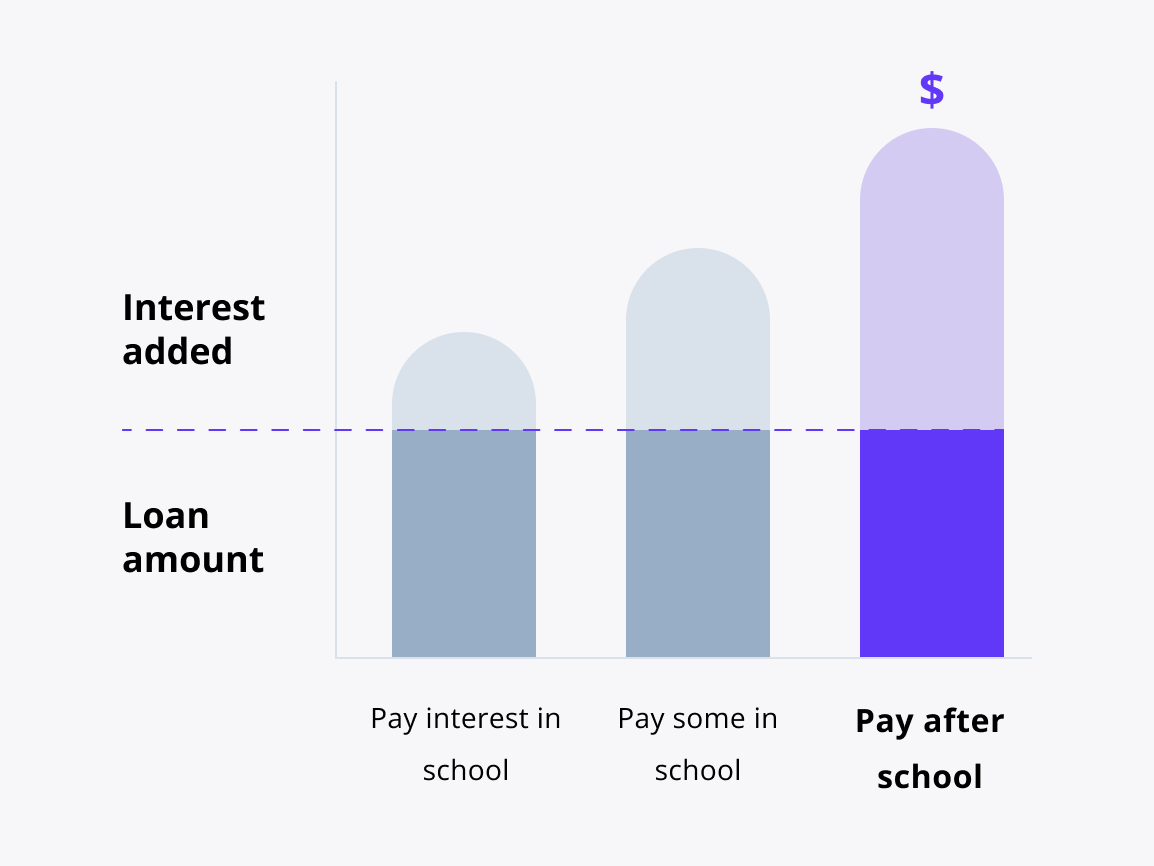
Graph showing deferred repayment option

Deferred repayment option

How does it work? 
You and your student have no scheduled payments during school and in grace.footnote 1

This is a great option if you and your student want more payment flexibility while your student is in school. 

Keep in mind: 
The total cost of your loan may be higher because the interest you don’t pay on their loan while they’re in school and grace will be added to the original amount they borrowed (principal amount).

FAQs

Have questions about cosigning? We've got answers.

footnote Borrow responsibly
We encourage students and families to start with savings, grants, scholarships, and federal student loans to pay for college. Evaluate all anticipated monthly loan payments, and how much the student expects to earn in the future, before considering a private student loan.

footnote Loans for Undergraduate & Career Training Students are not intended for graduate students and are subject to credit approval, identity verification, signed loan documents, and school certification. Student must attend a participating school. Student or cosigner must meet the age of majority in their state of residence. Students who are not U.S. citizens or U.S. permanent residents must reside in the U.S., attend school in the U.S., and apply with a creditworthy cosigner (who must be a U.S. citizen or U.S. permanent resident). Requested loan amount must be at least $1,000.

footnote 1. Advertised APRs for undergraduate students assume a $10,000 loan with a 4-year in-school period, a 6-month grace, and the longest loan term offered. Interest rates for variable rate loans may increase or decrease over the life of the loan based on changes to the 30-day Average Secured Overnight Financing Rate (SOFR) rounded up to the nearest one-eighth of one percent.  Advertised variable rates are the starting range of rates and may vary outside of that range over the life of the loan. Interest is charged starting when funds are sent to the school. With the Fixed and Deferred Repayment Options, the interest rate is higher than with the Interest Repayment Option and Unpaid Interest is added to the loan’s Current Principal at the end of the grace/separation period. To receive a 0.25 percentage point interest rate discount, the borrower or cosigner must enroll in auto debit through Sallie Mae. The discount applies only during active repayment for as long as the Current Amount Due or Designated Amount is successfully withdrawn from the authorized bank account each month. It may be suspended during forbearance or deferment.

footnote 2. Based on a comparison of the percentage of undergraduate students approved for a Sallie Mae Undergraduate Loan with a cosigner to the percentage of undergraduate students approved without a cosigner from October 1, 2024 through September 30, 2025.

footnote 3. For applications submitted directly to Sallie Mae, loan amount cannot exceed the cost of attendance less financial aid received, as certified by the school. Applications submitted to Sallie Mae through a partner website will be subject to a lower maximum loan request amount. Miscellaneous personal expenses (such as a laptop) may be included in the cost of attendance for students enrolled at least half-time. 

footnote 4. Only the borrower may apply for cosigner release. To do so, they must first meet the age of majority in their state and provide proof of graduation (or completion of certification program), income, and U.S. citizenship or permanent residency (if their status has changed since they applied). In the last 12 months, the borrower can’t have been past due on any loans serviced by Sallie Mae for 30 or more days or enrolled in any hardship forbearances or modified repayment programs. In addition, the borrower must have paid ahead or made 12 on-time principal and interest payments on each loan requested for release. The loan can’t be past due when the cosigner release application is processed. The borrower must also demonstrate the ability to assume full responsibility of the loan(s) individually and pass a credit review when the cosigner release application is processed that demonstrates a satisfactory credit history including but not limited to no: bankruptcy, foreclosure, student loan(s) in default or 90-day delinquencies in the last 24 months. Requirements are subject to change. 

footnote 5. Fee savings are based on a calculation of Sallie Mae loan volumes and PLUS origination fees charged over the past 10 years. This comparison reflects fee differences only and does not account for total costs of borrowing, which may vary depending on loan term, interest rate, and other factors.

footnote 6. Savings comparison assumes a freshman student receives a $10,000 Smart Option Student Loan with the most common variable rate as of January 2025 and the longest loan term offered.

footnote 7. Examples of typical transactions for a $10,000 Smart Option Student Loan with the most common fixed rate, Fixed Repayment Option, two disbursements, a 2-year in-school period, and a 6-month grace: For a borrower with the shortest loan term, it works out to 17.42% fixed APR, 27 payments of $25.00, 119 payments of $240.59 and one payment of $35.65, for a total loan cost of $29,340.86. For a borrower with the longest loan term, it works out to 17.54% fixed APR, 27 payments of $25.00, 177 payments of $215.60 and one payment of $143.45, for a total loan cost of $38,979.65. Loans that are subject to a $50 minimum principal and interest payment amount may receive a loan term that is less than 10 years. A variable APR may increase over the life of the loan. A fixed APR will not.

footnote Sallie Mae loans are made by Sallie Mae Bank. 

footnote Information advertised valid as of 03/12/2026.

footnote SALLIE MAE RESERVES THE RIGHT TO MODIFY OR DISCONTINUE PRODUCTS, SERVICES, AND BENEFITS AT ANY TIME WITHOUT NOTICE. CHECK SALLIEMAE.COM FOR THE MOST UP-TO-DATE PRODUCT INFORMATION.